Punta Gorda
Charlotte County, Florida
 Search homes in Punta Gorda
Popular searches: Burnt Store Isles homes for saleDeep Creek homes for salePunta Gorda luxury homesPunta Gorda luxury waterfront homesPunta Gorda commercial, $1M+Punta Gorda waterfront homesPunta Gorda sailboat access homesPunta Gorda Gulf access homesPunta Gorda homes with a boat liftPunta Gorda pool homesPunta Gorda lots for salePunta Gorda canal lots for salePunta Gorda new constructionPunta Gorda commercial real estate
Live Market Data
The Punta Gorda market right now
Punta Gorda Listings Summary
Currently listed from $34,999 to $2,995,000.
Punta Gorda vs. Charlotte County
Market Health
A market with more pendings than new listings is absorbing inventory; the reverse means selection is growing. Ask Bob what it means for your timing.
Residential listings for Punta Gorda from the MLS as of November 27, 2026. Figures update automatically and are deemed reliable but not guaranteed.
Get the Punta Gorda numbers by email once a month Free, one email a month, unsubscribe any time.
Punta Gorda is Bob's home. He was born and raised in Southwest Florida, he lives in Punta Gorda Isles, and his office is on West Marion Avenue. He has watched this town rebuild itself twice (after Charley and after Ian), and he has sold through both. So take the enthusiasm on this page with that context, and take the specifics as the ones he would want if he were the buyer.
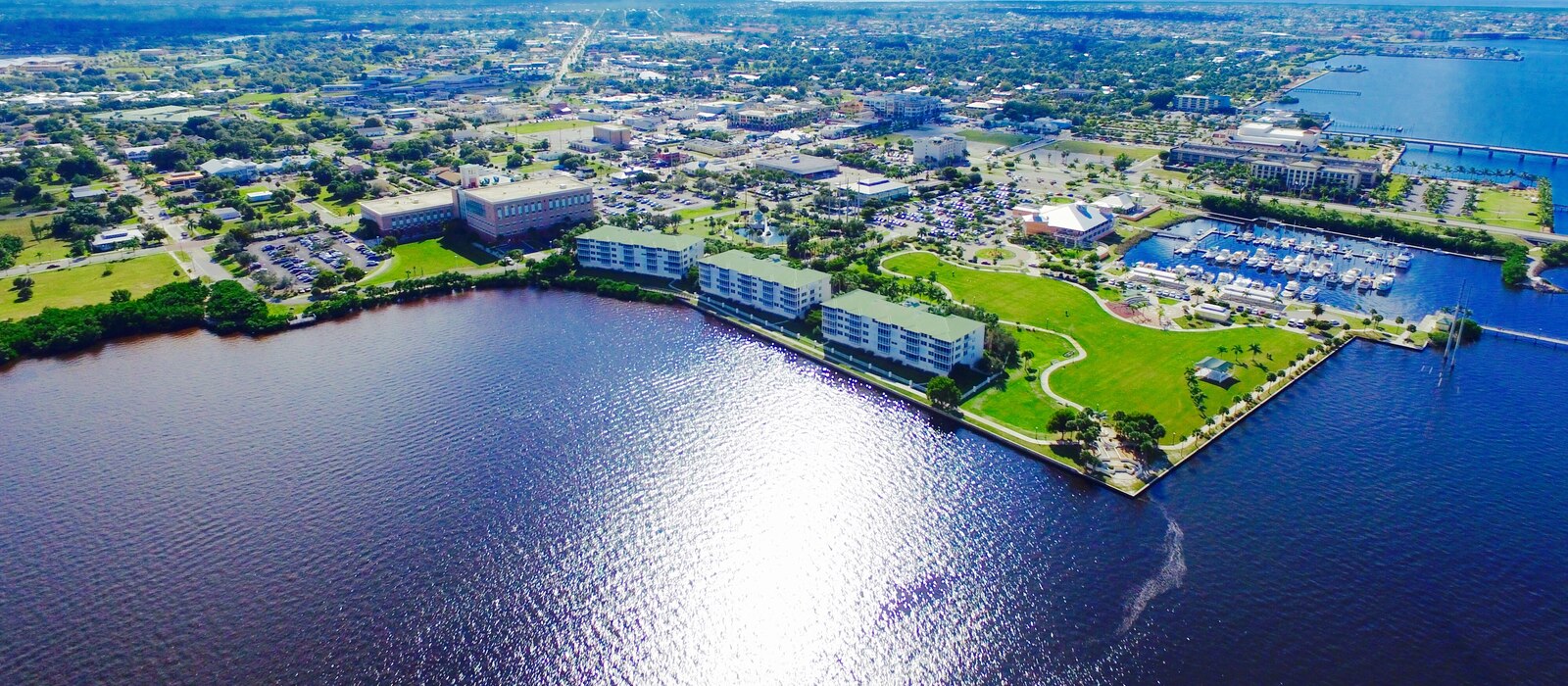
Punta Gorda is Charlotte County's seat: a walkable historic downtown on the south bank of the Peace River where it opens into Charlotte Harbor, with Fishermen's Village, Gilchrist Park, two weekend markets, a 2.3-mile Harborwalk, and deep-water canals running out to one of the largest estuaries in Florida. It is a small city (roughly 20,000 people across about 15 square miles of land), and it lives much bigger than that.
First: Are You Actually Buying in the City?
This is the question Bob asks before any other on a Punta Gorda listing, because a “Punta Gorda” mailing address usually means you are outside the city limits.
Burnt Store Marina, Deep Creek, Babcock Ranch, Heritage Landing, the Punta Gorda Airport and most of the golf courses carrying a Punta Gorda address are all in unincorporated Charlotte County, and Burnt Store Marina is not even in Charlotte County, it is in Lee. Charlotte County's own guidance to residents is simple: look at your tax bill and see whether there is a “City of Punta Gorda” line on it.
The difference is not cosmetic. It determines your millage, your utility provider, which building department issues your permits, which code enforcement office responds, and, importantly for anything on the water, which floodplain administrator you deal with. The City of Punta Gorda and unincorporated Charlotte County are separate participants in the federal flood insurance program with separate programs, separate permit desks and separate inspectors.
None of this is a reason to prefer one over the other. It is a reason to know which one you are buying into before you budget.
Trabue, the Railroad, and Seven Million Pounds of Fish
Colonel Isaac Hogden Trabue founded the settlement and named it after himself. He directed a surveyor to subdivide the land in 1884, and the “subdivision of Trabue” plat was filed in Manatee County on February 24, 1885; Charlotte County did not yet exist. The town incorporated on December 7, 1887, by which point the residents had renamed it Punta Gorda.
What made the place was the railroad. Trabue offered half his land to the Florida Southern Railroad in exchange for laying track and building a hotel, and the trains rolled in during August 1886. Punta Gorda became the point where rail met water: cattle, and fish packed in locally made ice, went north by freight, while wealthy winter visitors came south by Pullman car to the Hotel Punta Gorda. Barron Collier bought the hotel in 1924, renamed it the Hotel Charlotte Harbor, and added the stucco, the fourth-floor ballroom and a swimming pool 176 feet long. In 1920 alone the town shipped out more than seven million pounds of fish.
That commercial waterfront is still visible, most obviously at Fishermen's Village. The site began as the Maud Street Dock, built in 1928 to replace the older King Street Pier as the home of the local fishing industry, and it stayed a working fish dock into the 1970s. Rather than erase it, the city redeveloped it: Fishermen's Village opened on the same site in February 1980 and is now the town's waterfront dining, shopping and marina destination.
You can still see the bones of the industrial town if you know where to look: the 1928 Atlantic Coast Line depot on Taylor Road, the Punta Gorda Ice Plant on Tamiami Trail, and the Old First National Bank on West Marion are all individually listed on the National Register.
Three Historic Districts, and Only Some of Them Restrict You
Punta Gorda has three separate historic designations, and buyers regularly confuse what each one actually does.
The Punta Gorda Residential District is the federal one, listed on the National Register on January 7, 1991, covering roughly 52 acres within Trabue's original plat, bounded loosely by West Retta Esplanade, Berry Street, West Virginia Avenue and Taylor Street. It is about 125 mostly residential structures over 22 city blocks, wood-frame vernacular and American Queen Anne from the mid-1880s through the late 1910s, with 1920s land-boom buildings mixed in.
The Downtown Commercial Historic District, about 73 acres, and the Trabue–Woods Historic District, about 80 acres, are locally designated. Beyond those, five individually listed National Register structures sit outside the district boundaries, and over 150 structures are on the Florida Master Site File.
Here is the distinction that matters. National Register listing alone does not restrict what a private owner may do to their own building. Local designation does: the City's Historic Overlay district, established under Chapter 26 of the Land Development Regulations, carries design review for exterior alterations, with standards in the City's own historic district design guidelines. So a house can be on the National Register and be relatively unconstrained, or be locally designated and require review for a window replacement. Bob checks which applies to the specific address, every time.
One more consequence of historic status that almost nobody mentions, and it can be worth real money: properties individually listed on, or contributing to, a National Register district, or designated historic under an approved municipal program, may be exempt from the FEMA substantial improvement and substantial damage requirements. In a coastal city where the 50% rule can turn a renovation into a mandatory elevation, that exemption is significant. Verify eligibility for a specific address with the City before relying on it.
The Housing, and the Height You Can Build To
Downtown stock runs from restored early-1900s bungalows and Queen Annes near the historic core out through mid-century houses and newer infill construction within the city limits. Because the city rebuilt substantially after Charley in 2004 and again after Ian in 2022, a large share of what you will look at is either newer construction or has been renovated to current wind and flood standards, which shows up directly in insurance quotes and is always worth asking about at a showing.
The two big platted waterfront communities inside the city, Punta Gorda Isles and Burnt Store Isles, are governed very differently from one another, and the Isles have their own page. The short version: PGI let its original deed restrictions expire in 1995 and folded the standards into City code as a special overlay enforced by City code enforcement, while Burnt Store Isles has live recorded covenants enforced by an association with voluntary membership that nonetheless bind every owner and can result in a lien. Assuming “Isles equals HOA” in both cases gets it wrong.
On scale: there is no high-rise zoning in the City of Punta Gorda. The tallest by-right district is City Center downtown at 50 feet, with residential districts generally at 35 to 40 feet. And note the measuring point: the code measures height above base flood elevation, not above grade, which is a meaningful difference in a coastal city and part of why the downtown skyline stays low.
Water: The Canals, the Harbor, and the Assessment Nobody Mentions
The City maintains about 45 miles of canals and inlets and 91 miles of seawalls. That system is divided into two assessment districts, Punta Gorda Isles and Burnt Store Isles, each with its own budget funded by non-ad valorem assessments, overseen by a canal advisory committee of residents, with rates recommended to City Council and set at the September budget hearing.
That assessment funds dredging, an annual GIS-mapped seawall condition assessment, and mangrove trimming. It appears as a line on the tax bill, and it is one of the most common surprises for buyers who priced the house off millage alone. On any canal property Bob pulls the current assessment for the specific parcel and shows it to you.
Out front, Charlotte Harbor covers roughly 270 square miles and is the second-largest open-water estuary in the state, fed by the Peace, the Myakka and, around through Pine Island Sound, the Caloosahatchee. The Gasparilla Sound–Charlotte Harbor Aquatic Preserve, established in 1979, protects 84,501 acres of it, and its northeastern boundary is defined by the US-41 bridge over the Peace River. That is not trivia: dock, dredge and shoreline permitting work differently inside an aquatic preserve, so if you are planning a lift or a dock extension it is worth knowing which side of the line you are on. The harbor is also part of the Coastal and Heartland National Estuary Partnership, one of four National Estuary Program areas in Florida, designated in 1995.
For access, Laishley Park Marina downtown runs 85 slips with a public boat ramp and parking on the Peace River side. Fishermen's Village Marina has over 100 slips with a maximum length around 120 feet and roughly seven and a half feet at mean low water, though slip availability there has been affected by hurricane repairs, so confirm current status before counting on it. Ponce de Leon Park at the west end has a ramp, a small beach and a pier. Both US-41 bridges give roughly 45 feet of clearance.
Sailboat water versus bridge-limited canals is an address-by-address question here, as everywhere. Tell Bob the boat (length, draft and air draft with everything up), and he will verify the route from a specific dock before you fall for the view.
Downtown, and the Two Weekend Markets
The Harborwalk runs 2.3 miles along Charlotte Harbor from Trabue Park east to Fishermen's Village west, linking five waterfront parks (Trabue, Laishley, Gilchrist, Shreve and Pittman), with 24-hour access, restrooms at Gilchrist and Laishley, and free loaner bikes. Round trip it is 4.6 miles, and most of downtown is walkable or bikeable without a car.
Gilchrist Park is the heart of it: paved walking and biking paths along the harbor, tennis and pickleball courts, playgrounds and the best sunset views in the county.
If you want to understand what makes this town work, come on a weekend. Saturday mornings the Downtown Punta Gorda Farmers Market takes over Taylor Street between West Marion and West Olympia: dozens of vendors, local produce, baked goods and coastal crafts, 8am to 1pm October through April and 8am to noon the rest of the year. Sundays the energy moves to the Punta Gorda History Park at 501 Shreve Street beside the public library, where a smaller, more intimate market runs among the historic buildings and the Artisan Village, whose woodturning, fiber arts, pottery and glass-fusing guilds keep studios on site.
The Military Heritage Museum is at 900 West Marion Avenue in the IMPAC building, where it moved in April 2019: two floors plus a theater, flight simulators, interactive exhibits and a library of over 5,000 volumes of military history. Founded in 2001, it has moved around town four times and finally has the space it deserves.
The Charlotte Harbor Event and Conference Center is at 75 Taylor Street. Despite the name it is downtown on the south side of the river, not in the community called Charlotte Harbor on the north shore, another local naming quirk worth knowing.
Punta Gorda Airport handled over 2.28 million passengers in 2025, up 18.5%, with Allegiant flying nonstop to more than fifty destinations and seasonal Sun Country service to Minneapolis. A 50,000-square-foot terminal expansion is expected to open in 2027. It is a genuinely underrated advantage of living here: for a small city, the ability to fly nonstop to that many places from a fifteen-minute drive is unusual. The airport itself is in unincorporated county, not the city.
A Golfer's Home Base
If you play, this is an easy place to live. Roughly ten clubs carry a Punta Gorda address: St. Andrews South and Twin Isles Country Club, both private and both right by Punta Gorda Isles; Deep Creek, a semi-private Mark McCumber layout open to the public; Seminole Lakes; the 27 holes at Burnt Store Marina Country Club; Heritage Landing; Blue Heron Pines; and out at Babcock Ranch, Babcock National and Webb's Reserve.
Worth knowing: only about three of those are actually inside the city limits. The rest carry a Punta Gorda mailing address in unincorporated county, which is fine; it is just another instance of the same address-versus-jurisdiction point.
Widen the radius and the options multiply. Rotonda Golf & Country Club, about half an hour southwest, is a destination in its own right with five courses and 99 holes. Add Riverwood and the Port Charlotte clubs, Coral Creek toward Placida, and the courses up through North Port, Venice and Sarasota, and there are dozens of layouts inside a thirty-minute drive.
Access models (public, semi-private, private, bundled) change often enough that Bob confirms current terms with the club rather than repeating a listing. And if golf is a priority, tell him whether you want to live inside a golf community or simply near several. It meaningfully changes which streets to look at.
Healthcare: What Actually Changed
This one matters and a lot of older information is wrong, so here is where it stands.
The hospital in Punta Gorda, which opened on August 17, 1947 as Charlotte Hospital with twelve beds and went through a long list of names, most recently ShorePoint Health Punta Gorda, was evacuated ahead of Hurricane Helene in September 2024, damaged further by Milton, and permanently closed on December 19, 2024. AdventHealth completed a $260 million purchase on March 1, 2025 but reopened only AdventHealth Port Charlotte, a 254-bed facility, which is now the nearest full-service hospital.
A freestanding emergency department has been announced for Jones Loop Road and Mac Ever Street, but no timeline had been published as of Bob's last check.
So if you are moving here in retirement, map your actual drive to Port Charlotte rather than assuming there is a hospital downtown. It is not a long drive, but it is a different answer than it was two years ago, and Bob would rather you hear it from him than discover it.
Storms, Flood Zones and the 50% Rule
Bob has been through all of these and will give you the honest version.
Hurricane Charley came ashore at Cayo Costa on August 13, 2004 as a 150 mph storm, and the eye crossed over Punta Gorda about an hour later. The airport's weather instrument recorded 78 knots sustained with a 97-knot gust before it failed. That storm reset this town.
Hurricane Ian made landfall near Punta Gorda at 2035 UTC on September 28, 2022, at 125 knots and 945 millibars, with water running five to eight feet above ground level locally. Statewide it was the costliest hurricane in Florida's history.
Then 2024 delivered a different lesson. Helene made landfall at Perry, more than two hundred miles away, and still pushed three to five feet of surge into Charlotte Harbor. Around 1,900 Charlotte County structures took major damage, most of it from water rather than wind. Milton came ashore at Siesta Key and put five to eight feet into the northern harbor, with a six-foot high-water mark at the Punta Gorda marina. Neither of those storms hit Punta Gorda directly. Both of them flooded it. If you take one thing from this section, take that.
On the paperwork: the City's current Flood Insurance Rate Maps became effective December 15, 2022 and introduced the Coastal A Zone (the Limit of Moderate Wave Action), identifying areas expected to see wave crests of one and a half to three feet in a base flood event. The City's floodplain administrator is at 941-575-3344 and the building department floodplain team at 941-575-3324, and Bob calls them rather than guessing.
The good news on cost: both the City of Punta Gorda and Charlotte County hold a Community Rating System Class 5 rating, which means up to 25% off flood insurance premiums for properties in the high-risk zones. That is among the better ratings in the state and it is worth real money annually. Note again that they are separate communities with separate programs: moving from a city address to a county address changes your floodplain administrator.
And on the 50% rule: once a structure's damage or improvements exceed half its market value, the City requires the finished floor to be brought to base flood elevation plus a foot of freeboard in A zones, and the lowest horizontal structural member to that height in V zones. The costs that count toward the threshold include materials, labor, structural repairs, demolition, contractor overhead, utility work, elevation and code-compliance expenses, and interior and exterior finishes, more than most people expect. There are four accepted ways to establish market value, and there is the historic-building exemption noted above. After Ian the City passed an emergency ordinance replacing the old five-year cumulative lookback with individual review of each repair request; whether that approach is still in force is exactly the kind of thing Bob confirms with the building department for your specific project rather than assuming.
Bob's standing advice, here as everywhere on this coast: get the elevation certificate, the current flood zone for the parcel, the full permit history, and a written insurance quote, all inside your inspection period.
Schools
Punta Gorda is served by Charlotte County Public Schools. Assignment depends on the specific address and boundaries change from time to time, so the district's own school locator is the authoritative source for any particular home, and the district's locator carries its own note that it is a guide and that families should call the school to confirm.
Florida law limits what Bob can say about school quality, and he takes that seriously. What he will do is point you to the district's resources for any address you are considering, and encourage you to visit the campuses and form your own view.
Punta Gorda is a small, historic, storm-tested waterfront city that punches far above its size, and having grown up here and worked through two rebuilds, Bob knows its streets, its canals and its paperwork about as well as anyone. Whether you are looking at a bungalow in the historic district, a sailboat-water canal home, or something out in the county with a Punta Gorda address, the same four things decide it: which jurisdiction, what the flood zone says, what the assessments really cost, and what the permit history shows. Bob would be glad to go find out with you.