Buyers › Waterfront Ownership
Buying on a canal:
seawalls, lot shapes & what you actually own
Two canal homes on the same street, at the same price, can be very different purchases. One may have four times the water frontage of the other. One may sit behind a seawall the City maintains and the other behind a wall that is entirely your problem. Neither difference shows up in a listing photo.
Frontage by lot shape · How seawalls fail and what to look for · The Hurricane Ian repair zones · Dock rules · Verified August 2026
Ask this before you write an offer on a PGI waterfront home
Which Hurricane Ian repair zone is this property in, and is its seawall on the list? The City divided Punta Gorda Isles into five work zones after Ian and publishes a repair schedule that looks six months ahead, updated monthly, with failures triaged high, medium or low priority. Burnt Store Isles repairs are complete. PGI is still in active restoration.
Almost nobody asks. It costs you nothing to find out, and it tells you whether the wall behind your new house is scheduled for replacement next quarter or three years out, which affects your use of the yard, where you can put a dock, and when heavy equipment will be parked behind your house. Send Bob an address and he will check the current zone schedule.
Repair status verified against the City of Punta Gorda 16 August 2026. Schedules move. Confirm current status with Public Works at (941) 575-5050.
Part One
Not all “waterfront” is the same amount of water
On the Punta Gorda canal grid, where your lot sits along the canal decides how much seawall you own, and the spread is enormous. A tip lot at the end of the street carries four to six times the water frontage of a corner lot at the head of the canal. Both are advertised the same way. This is one of the biggest silent value gaps in this market.
Tip lot
160–180 ftThe two lots on the rounded corners at the end of the street, where the canal turns into the cross canal. Straight frontage along the canal plus the whole curve around the corner: the largest seawall on the grid, water on more than one side, and the biggest premium. Deservedly.
Key lot
~140 ftThe lot at the dead center of the turnaround, facing straight across the cross canal at the homes on the far bank. A long seawall across the back and a short frontage on the street: a lot of water for a modest street presence, and no through traffic at all.
Cul-de-sac lot
~100 ftThe two lots on either side at the beginning of the cul-de-sac turnaround, just before the Tip lots. Generous water frontage, and the street traffic ends at your door.
Standard lot
~80 ftThe workhorse of the canal grid: a standard 80′ × 120′ lot running back from the water. Comfortable for a dock and a lift. Most canal homes are on one of these.
End lot
~65 ftSits square against the flat end wall of the canal, directly between the two Corner lots. Modest frontage, but it looks straight down the length of the canal, so the view out the back is the longest on the street. People buy these for the view, not the seawall.
Butt lot
50–60 ftSits between the Standard lots and the Corner lot as the canal narrows toward its head. Noticeably tight at the seawall, and dock placement gets constrained by the 45-degree rule further down this page.
Corner lot
30–40 ftThe two lots flanking the End lot at the head of the canal. The canal’s corners are cut off at an angle where the end wall meets the side wall, and that short clipped diagonal is all the water a Corner lot gets. The smallest frontage on the grid, frequently on a perfectly good-sized lot: large yard, almost no seawall. This is the one that surprises people.
How they sit on the grid
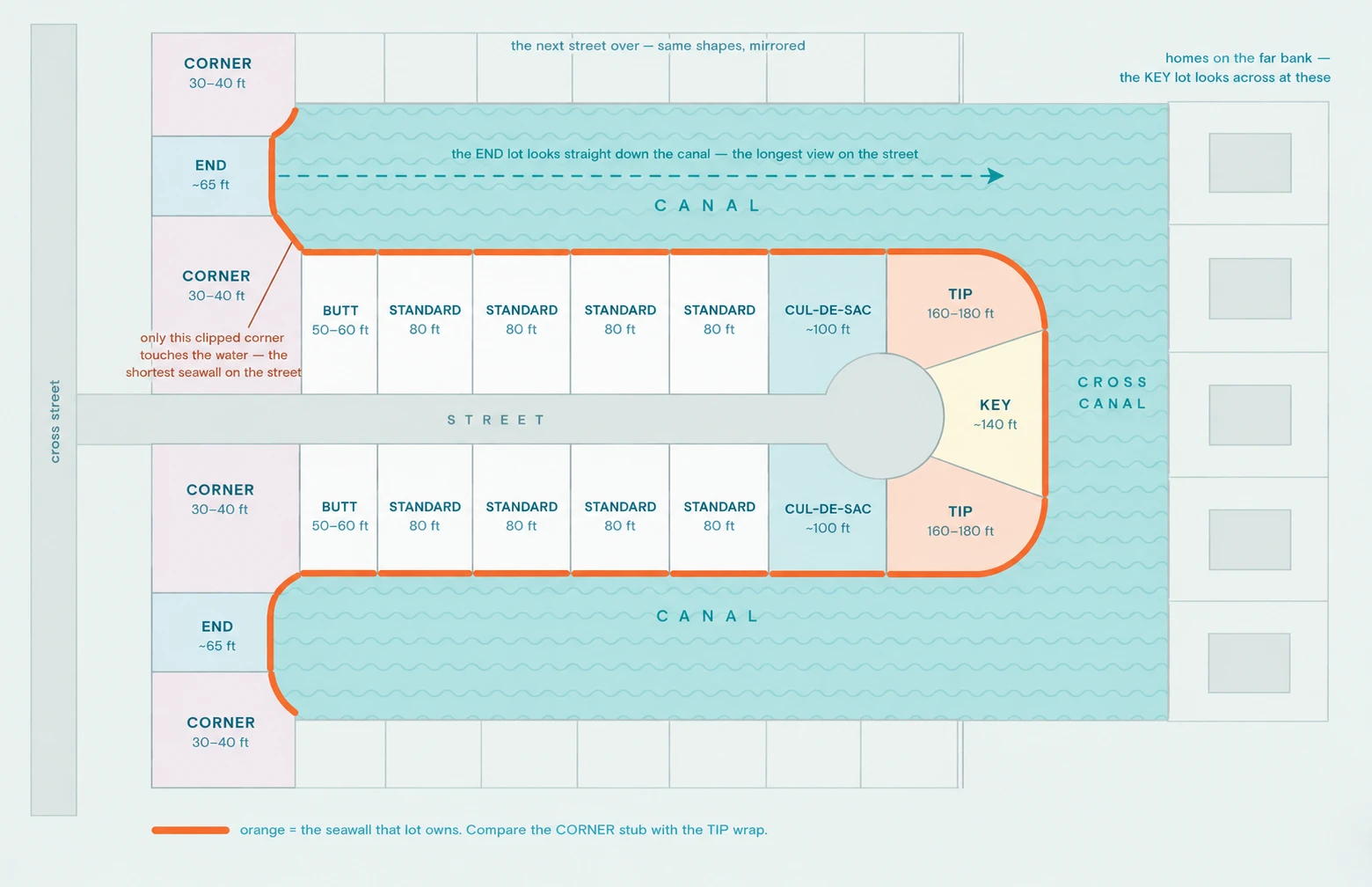
Tap the diagram to open it full size.
Use these as ranges, not promises. The figures above describe how the Punta Gorda and Burnt Store Isles canal grid was typically platted. Any individual parcel is governed by its survey and the county property appraiser’s record, and plenty of lots are simply nonstandard: odd shapes fitting none of these descriptions. Before you offer on a waterfront home, get the actual frontage measured. Bob pulls it as a matter of course.
of seawall the City of Punta Gorda maintains
Part Two
The best thing about buying in PGI is on your tax bill
Punta Gorda Isles and Burnt Store Isles are canal maintenance assessment districts. The non-ad-valorem assessment on your tax bill funds canal dredging, mangrove trimming, an annual survey of every seawall in the system, and (the important part)the repair and replacement of the seawalls themselves.
That is unusual, and it is worth real money. In most Florida canal communities a failing seawall is the individual owner’s problem and a five-figure bill that arrives without warning. Port Charlotte’s waterway districts fund dredging and channel markers but not seawalls. Cape Coral is different again. In PGI and BSI, the City owns that problem.
Each district has a resident canal advisory committee that recommends the annual rate to City Council, set at the first budget hearing in September. Every year, typically in winter when tides are low, City crews motor the entire canal system and log the condition of every wall and cap into a GIS mapping system. That survey is what drives the replacement schedule.
The practical point for a buyer: when you compare a canal home inside city limits against one outside it, you are not comparing like with like. Ask Bob to show you the difference on a specific pair of addresses.
Part Three
What you are actually looking at
A seawall is not just a wall. Knowing the five parts by name makes the next section (how they fail) something you can spot from the lawn during a showing.
- Panel
- A reinforced concrete slab about 6″ thick, set vertically. The sides interlock tongue-and-groove. Modern panels are 10′ long with protected rebar and stronger concrete than the originals.
- Cap
- The concrete box along the top that ties all the panels together and keeps them aligned.
- Tie-back rod
- Steel rod running back from the wall into your yard. It is what stops the wall falling into the canal.
- Deadman
- A large concrete block buried 12′ to 20′ back in the yard that the tie-back anchors into.
- Berm & rip rap
- The soil supporting the foot of the wall underwater. Where the berm is inadequate, stone rip rap is placed instead.
- Weep hole
- A 2″ hole letting water drain from the land side so pressure does not build up behind the wall.
Part Four
Four ways a seawall fails, and what each looks like
This is the most practically useful thing on this page. You can check all four from the lawn in about two minutes, and it is worth doing on every canal home you walk.
Joint separation
Cause Age, settling, or too little berm supporting the foot of the wall.
What you can see Depressions in the lawn behind the wall, and backfill visible in the water at the panel joints, easiest to spot at low tide.
Tie-back or cap failure
Cause Brackish water corroding the steel inside the cap or the tie-back rods. Also caused by anyone drilling into or bolting anything onto the cap.
What you can see A cracking or crumbling cap, and panels that look wavy, sagging or tilted toward the water. These two usually show up together.
Toe and berm failure
Cause The supporting berm at the base of the panels washing away, usually from wave action or fast tidal current.
What you can see The cap rotating, and panels moving or cracking.
Break at the waterline
Cause Age, corrosion, and uneven water pressure from the land side.
What you can see Horizontal cracking along the oyster line at the waterline. Panels eventually break along that line.
If you spot any of it, that is not a reason to walk away: inside PGI or BSI it is the City’s repair, not yours. It is a reason to ask which repair zone the property sits in and where it falls on the schedule, because a wall due for replacement means crews, equipment and a stripped-back yard for eight to ten weeks at some point. Report anything you see to Public Works on (941) 575-5050.
Part Five
Docks, lifts and the rules nobody mentions at showings
What you can generally build
- A freestanding dock projecting no more than 10 feet waterward of the seawall
- Boat lifts and pilings, with the number set by your seawall length and the canal width
- Everything kept inside 45-degree lines projected waterward from your seawall at the side property lines
- 50 feet of navigable channel must stay clear (40 feet in Burnt Store Isles perimeter canals seawalled on one side only)
Anything outside these limits needs a special permit and a public hearing before the Canal Advisory Committee. Start with the Building Division, (941) 575-3324.
What you may never do
- Paint, drill into, or attach anything to the seawall or cap, including cleats to tie a boat
- Discharge any liquid into the canal, pool overflow and drain pipes included
- Put grass clippings, vegetation, trash, fish waste, fertilizer or chemicals in the water
- Plant trees or bushes within six feet of the seawall; the City cannot maintain the wall around them, and they will be removed when work is done
- Repair the cap or wall yourself. It is the City’s wall to fix.
Broken or rotted docks, lifts and pilings are the owner’s responsibility to repair or remove.
Five habits that protect the wall and your resale
- Keep sprinkler heads and pool discharge six feet back from the seawall.
- Plant nothing but grass within six feet of the cap, and keep large trees well away.
- Let the grass grow halfway over the cap. It prevents rutting and helps water run off into the canal instead of pooling behind the wall.
- Keep heavy equipment off the seawall perimeter. Riding a mower along the cap repeatedly cuts ruts; run two wheels up on the cap instead.
- Do boat painting and major repairs over land, and use phosphate-free biodegradable products when washing on the water.
The One Nobody Warns You About
Your canal will smell for two weeks, once a year
As the weather cools, the canal flips. Bottom water (silt, decomposing vegetation, debris) rises to the surface while surface water sinks. It smells like stagnant water and it looks alarming.
It is completely natural, it happens roughly once a year, and it usually clears in about two weeks. Nearly every first-winter owner thinks something has gone wrong with their canal or their neighbor has done something. Nothing has. Keeping clippings and vegetation out of the water reduces it. If it lingers well past a fortnight, call Public Works.
Bob mentions it because it is exactly the kind of thing that turns a delighted new owner into a worried one, entirely unnecessarily.
Go to the Source
Official waterfront resources
Canal rules, repair schedules and permitting change. When it matters to a decision, check the City rather than a real estate website, including this one.
Assessments, dredging, seawall program, the Waterfront Property Owner’s Guide Hurricane Ian Seawall Repairs
The five PGI work zones and the rolling repair schedule Building Division: dock & lift permits
(941) 575-3324 · 126 Harvey Street, 2nd floor Bob’s Boaters Access Guide
Which canals reach open water, bridge clearances, marinas and clubs
Questions
Waterfront ownership, answered
Who pays to repair a seawall in Punta Gorda Isles or Burnt Store Isles?
The City does. Punta Gorda Isles and Burnt Store Isles are canal maintenance assessment districts, and the assessment on your tax bill funds canal dredging, an annual survey of every seawall in the system, mangrove trimming, and the repair and replacement of seawalls and caps. This is genuinely unusual. In most Florida canal communities, including much of Port Charlotte and Cape Coral, a failing seawall is the individual owner’s problem and a five-figure bill. It is one of the strongest and least advertised arguments for buying inside city limits here.
Is the seawall repaired after Hurricane Ian yet?
It depends where the property is. Burnt Store Isles repairs are complete. Punta Gorda Isles is still in active restoration: the City split PGI into five work zones and publishes a rolling repair schedule looking six months ahead, updated monthly, with failures triaged as high, medium or low priority. If you are buying a PGI waterfront home, ask which zone it is in and whether that specific seawall is on the list. Most buyers never think to ask.
How much water frontage does a canal lot actually have?
It varies enormously by lot shape, and that is the part buyers miss. On the typical Punta Gorda canal grid a tip lot carries roughly 160 to 180 feet of water frontage while a corner lot may carry only 30 to 40 feet, four to six times the difference. Both get advertised as "waterfront." These are typical ranges, not guarantees: the survey and the property appraiser’s record govern any specific parcel.
What can I build on my seawall or in the canal?
On the seawall itself, nothing. City rules prohibit painting it, drilling into it, or attaching anything to the wall or cap, including cleats to tie a boat to. In the canal, a single-family lot may generally have a freestanding dock projecting no more than 10 feet waterward, with structures kept inside 45-degree lines projected from your seawall at the side property lines, and 50 feet of navigable channel maintained (40 feet in Burnt Store Isles perimeter canals seawalled on one side only). Anything outside those limits needs a special permit and a public hearing before the Canal Advisory Committee. Start with the Building Division at 941-575-3324.
Why does the canal smell for a couple of weeks in the winter?
It is natural and it is temporary. As air temperatures drop the canal "flips": bottom water carrying silt and decomposing vegetation rises to the surface while surface water sinks. It smells like stagnant water, it happens roughly once a year, and it typically clears in about two weeks. Nearly every first-winter owner thinks something has gone wrong with their canal. Nothing has. Keeping grass clippings and vegetation out of the water reduces it.
Can I tie my boat to the seawall during a hurricane?
No. City ordinance specifically prohibits attaching or resting any object or structure against the seawall or cap, cleats and anchors included. For a boat staying at the dock, the guidance is to double all lines, rig crossing spring lines, use lines one size larger than normal, and secure to screw-in anchors set at least 12 feet back from the canal edge. Chain for the first fifteen feet from the anchor stops the line chafing over the cap. And do not stay aboard.
What should I look at during a walkthrough of a canal home?
Walk the seawall specifically, and look for four things: depressions or soft spots in the lawn within six feet of the wall; a cap that is cracking, crumbling or spalling; panels that look wavy, sagging or tilted toward the water; and horizontal cracking along the oyster line at the waterline. Also check whether anything has been planted, built or bolted within six feet of the cap, because the City will remove it when the wall is worked on. Bring these up during your inspection period, not after.
Do canal assessments and seawall coverage apply outside Punta Gorda city limits?
No, and this is a common and expensive misunderstanding. The city-maintained seawall program covers Punta Gorda Isles and Burnt Store Isles inside city limits. Port Charlotte’s waterway MSBUs fund dredging and channel markers but not seawalls; there, the seawall is the owner’s biggest deferred-maintenance item. Cape Coral is different again. Always confirm which jurisdiction and which program a specific address falls under before you assume anything about who fixes the wall.
Bob Helphenstine is a Realtor®, not a marine contractor, engineer or surveyor. This page is general education, compiled from the City of Punta Gorda’s published canal and waterfront materials and verified against the City in August 2026. Water frontage figures are typical ranges for how the PGI and BSI canal grid was platted; they are not a representation about any specific parcel, which is governed by its survey and the property appraiser’s record. Canal rules, assessment rates, permitting requirements and repair schedules all change. Confirm anything that matters to your decision with the City of Punta Gorda directly, and have the seawall and dock inspected during your inspection period.
Looking at a canal home?
Send Bob the address and he will pull the actual water frontage, the lot shape, which repair zone it sits in, and whether the seawall is on the City’s schedule before your inspection period runs out.