Port Charlotte
Charlotte County, Florida
 Search homes in Port Charlotte
Popular searches: Port Charlotte luxury homesPort Charlotte commercial, $1M+Port Charlotte waterfront homesPort Charlotte pool homesPort Charlotte lots for salePort Charlotte commercial real estate
Live Market Data
The Port Charlotte market right now
Port Charlotte Listings Summary
Currently listed from $29,999 to $2,500,000.
Port Charlotte vs. Charlotte County
Market Health
A market with more pendings than new listings is absorbing inventory; the reverse means selection is growing. Ask Bob what it means for your timing.
Residential listings for Port Charlotte from the MLS as of November 27, 2026. Figures update automatically and are deemed reliable but not guaranteed.
Get the Port Charlotte numbers by email once a month Free, one email a month, unsubscribe any time.
Port Charlotte sits directly across the Peace River from Punta Gorda, close enough that the two bridges on US 41 make it feel like one town with a river running through it. It is the largest community in Charlotte County by a wide margin, and it is also the most misunderstood, because Port Charlotte was never really built as a town. It was sold as lots.
That single fact explains almost everything a buyer notices here: why there is no old downtown, why street names run in themed alphabetical blocks, why a 2024 build can sit between houses from 1978 and 1961, and why the price range is the widest in the county. Understand how Port Charlotte came to be and the rest of it makes sense.
Ten Dollars Down and Ten Dollars a Month
Port Charlotte is the work of General Development Corporation and the Mackle brothers, who began selling installment lot contracts here in late 1955. The first home sites went for $699. Later national advertising offered lots at $795 (ten dollars down and ten dollars a month) to buyers in the north who in many cases had never set foot in Florida.
The company started with roughly 5,000 acres carved out of a far larger Charlotte County tract, and engineers eventually laid out the full 80,000 acres with more than 200,000 planned home sites. General Development went on to build North Port, Port St. Lucie and Palm Bay on the same model.
The company's ending matters to buyers too, because it is why so many lots sat vacant for decades. GDC pleaded guilty to federal mail fraud in March 1990 and filed for bankruptcy protection weeks later over how homes had been sold. Atlantic Gulf Communities emerged from that bankruptcy holding the remaining vacant land. The result is a community platted for a population it never reached on schedule, and a still-substantial supply of buildable infill lots between existing homes.
What This Means When You Are House Hunting
Port Charlotte is a patchwork, and that is its strength. Because lots were sold individually rather than developed in phases, you can find a 1970s three-bedroom on a quarter acre a few streets from new construction, and both on the same tax roll.
Deed restrictions vary block by block. There are genuinely deed-restricted, amenity-carrying communities inside the Port Charlotte postal area (Riverwood, Kings Gate and Maple Leaf Golf & Country Club among them), and there are large stretches of platted grid where restrictions are minimal or absent. You will hear people say most Port Charlotte lots have no HOA. That is broadly the impression on the ground, but Bob would never let a client rely on it. Recorded restrictions run with the individual parcel, and checking them is a five-minute job he does before an offer is written.
One more piece of local vocabulary: South Gulf Cove carries a Port Charlotte mailing address but is a distinct canal community out on the Cape Haze side, with its own association and its own boating situation. If someone tells you they are looking at Port Charlotte and they mean South Gulf Cove, those are two different conversations.
The Water, and the Lock Nobody Expects
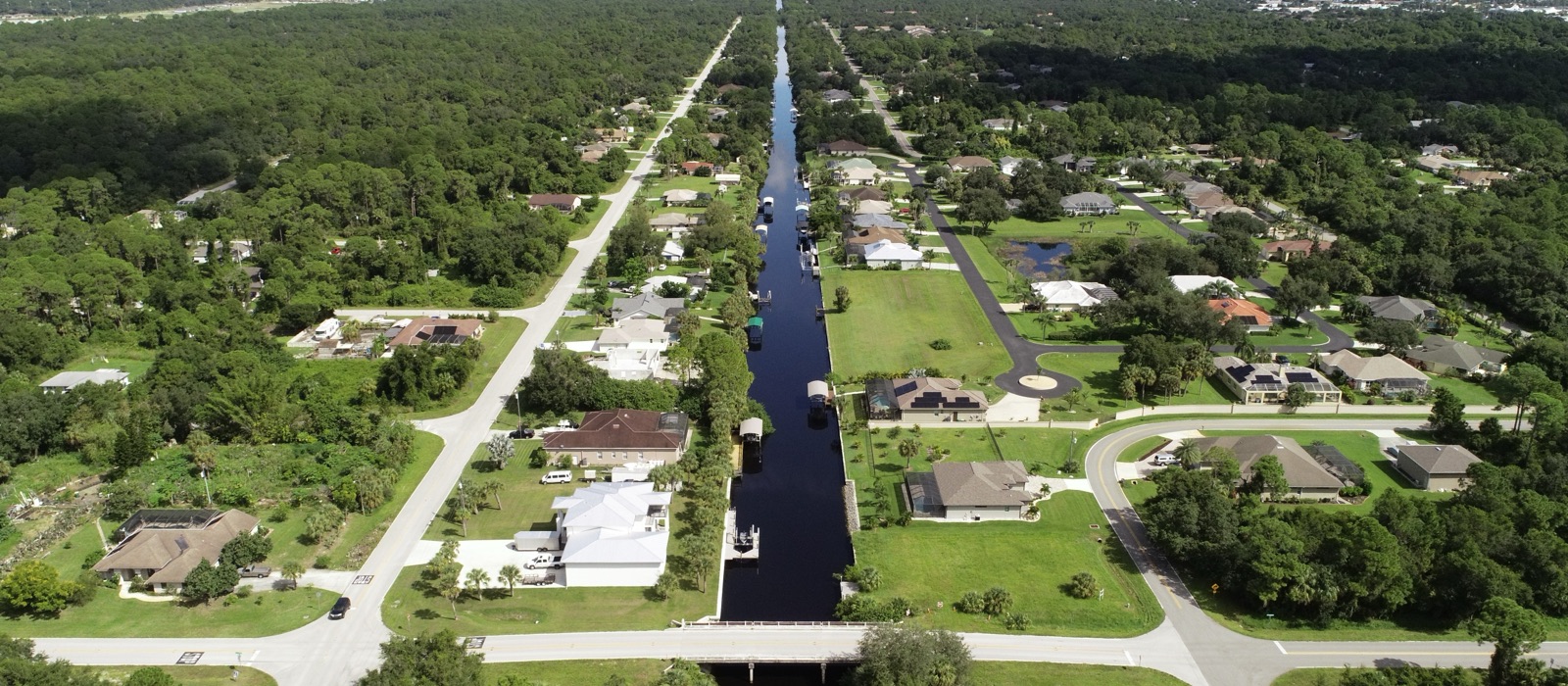
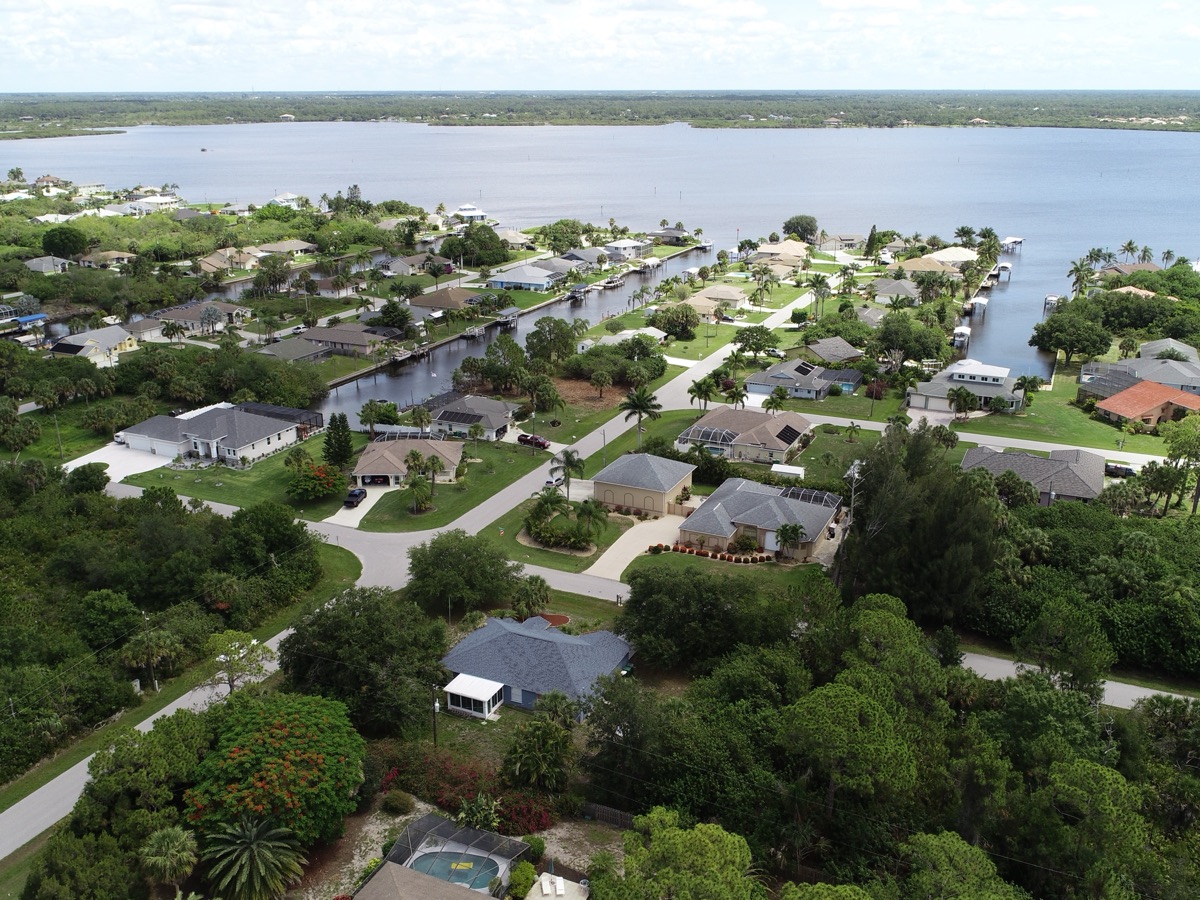
Port Charlotte has extensive dredged saltwater canal systems along the Peace River and Charlotte Harbor side, and the county maintains several of them through waterway MSBUs that fund dredging and navigation markers. Worth knowing: those units fund the waterway, not your seawall. Seawall maintenance is the owner's, and on a canal home it is the single biggest deferred-maintenance item Bob looks for.
South Gulf Cove has something almost no other Florida residential community does: an operating boat lock, run by the county, that regulates flow between Charlotte Harbor and the interior canals and keeps depths up. It closed for several months and reopened in May 2025, currently running noon to 7 p.m. with times subject to tides. The county has also been pursuing a parallel-locks project. If you are buying inside the lock, the lock's hours are part of your boating life, so ask Bob about the current schedule rather than trusting an old listing.
Public ramps in the area include El Jobean, Port Charlotte Beach Park, Spring Lake Park and South Gulf Cove Park. On sailboat access (meaning a route to open water with no fixed bridge overhead), Bob does not make canal-by-canal promises in writing. Bridge clearances and controlling depths need to be checked against the chart and the specific bridge for the specific address, and that is exactly the kind of thing he will go look at with you before you fall in love with a dock.
Golf Without Leaving the ZIP Code
Kings Gate, Maple Leaf Golf & Country Club, Port Charlotte Golf Club and Riverwood Golf Club are all semi-private courses within Port Charlotte itself, and The Cove of Rotonda Golf Center is public. Cross the river and Deep Creek and Seminole Lakes are semi-private, with St. Andrews South and Twin Isles private in Punta Gorda. North Port adds Charlotte Harbor National and Heron Creek.
For a golfer, this stretch of Charlotte County is genuinely dense with options at a range of price points, which is a large part of why people retire here rather than further south.
Everyday Life
Port Charlotte Town Center opened in 1989 and is still the county's main enclosed mall, roughly a million square feet, anchored now by Dillard's, JCPenney, Bealls and a Regal cinema. Sears and Macy's have both closed in recent years, which is the national story rather than a local one.
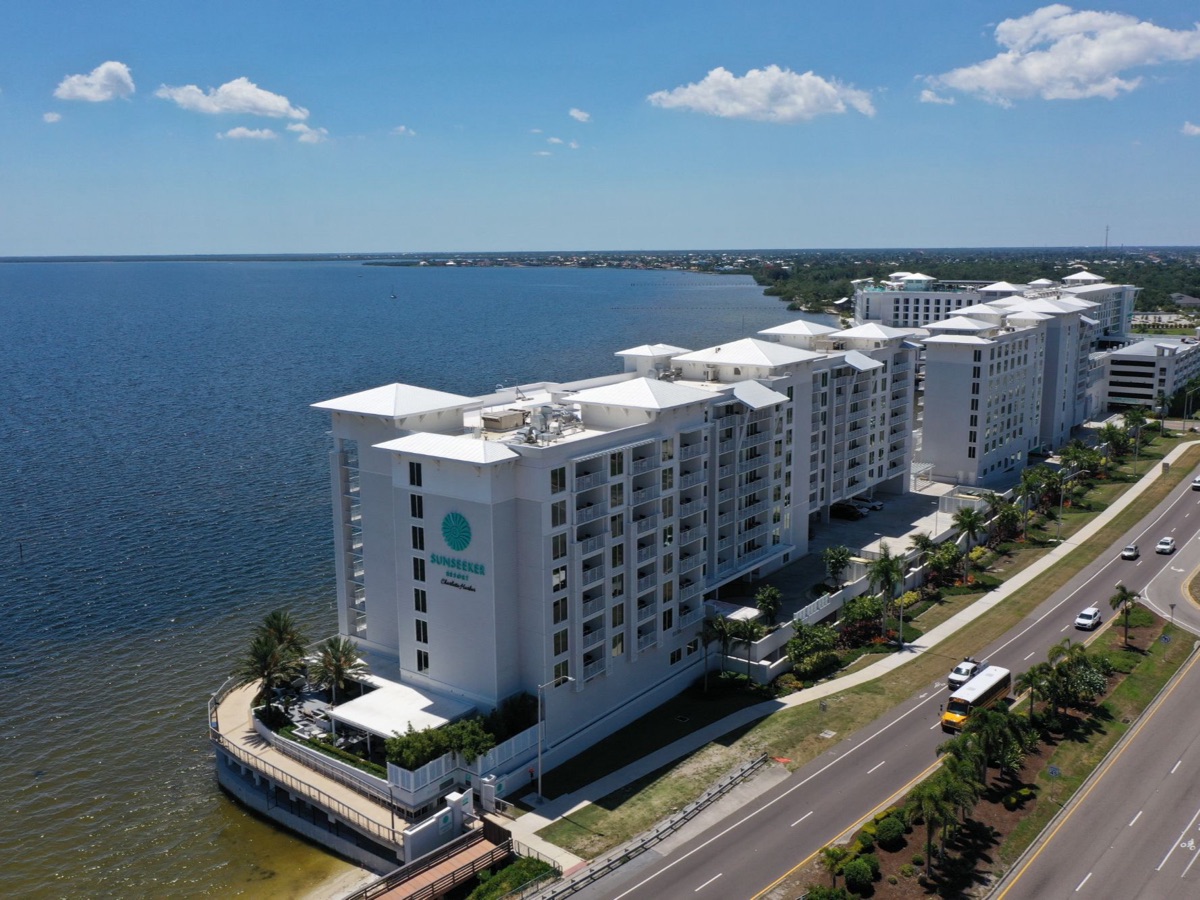
Sunseeker Resort Charlotte Harbor opened to guests in December 2023 on the waterfront, built by Allegiant and since acquired by Blackstone Real Estate. It changed the skyline on this side of the harbor and added a genuine resort-scale dining and event destination that Charlotte County simply did not have before.
Charlotte Sports Park on El Jobean Road is the spring training home of the Tampa Bay Rays, on 82 acres with about 7,500 seats and Tippecanoe Environmental Park next door.
For medical, HCA Florida Fawcett Hospital on Olean Boulevard is a 238-bed acute care hospital, and AdventHealth Port Charlotte (formerly St. Joseph's, then Peace River Regional, then Bayfront, then ShorePoint) came under AdventHealth in March 2025. It is worth knowing that ShorePoint Health Punta Gorda has been closed for inpatient care since storm damage in 2024, which shifted more of the county's inpatient volume to the Port Charlotte side.
What Is Under Construction, and What Is Closed
Two things a buyer should know before they drive around and wonder what happened.
Port Charlotte Beach Park, the 16-acre bayfront park with the heated pool, fishing pier and boat ramp, took damage from Ian, Helene and Milton and is in the middle of a major rebuild. Ground broke in October 2025 on a new elevated recreation center and pool house, with reopening expected late 2026 or early 2027. Some courts and the boat ramp have reopened; Boat Ramp A has not.
The Cultural Center of Charlotte County is closed from hurricane damage, and the Port Charlotte Library closes permanently after July 2026 with demolition anticipated that fall. A combined replacement (library, cultural center, historical center and theater) is planned, but construction is not scheduled until 2028 and depends on voters approving the sales tax in November 2026. If cultural amenities matter to you, that is an honest gap in Port Charlotte right now, and Punta Gorda across the river is where people are going in the meantime.
Flood Zones, the 50% Rule, and Sewer Assessments
Charlotte County's current flood maps became effective on 15 December 2022, replacing maps that had been in place since 2003. The update introduced a Coastal A Zone (areas expecting 1.5 to 3 feet of wave action, regulated to the stricter V-zone standard) and switched the elevation datum to NAVD88, which reads on average about 1.15 feet lower than the old datum. Roughly 4,400 parcels came out of the high-risk zone and about 3,900 went in. Around half the county sits in a FEMA high-risk zone.
The good news is that Charlotte County holds a CRS Class 5 rating, which earns property owners in high-risk zones up to 25% off National Flood Insurance premiums. That discount is real money and it is not available everywhere.
The rule that surprises people is the 50% rule. In a high-risk zone, if the cost of repairs or improvements reaches half the structure's market value (land excluded), the entire building has to be brought up to current Florida Building Code, including elevation. On an older Port Charlotte home this can turn a renovation into a rebuild. Bob checks it before a client makes an offer on anything they plan to substantially remodel.
The other line item people miss is septic-to-sewer conversion. Charlotte County has a long-running program converting neighborhoods from septic to central sewer, prioritized by proximity to waterways and septic age and density. The Ackerman Wastewater Expansion in Port Charlotte covers roughly 1,300 properties, and its budget was raised to about $70.6 million in May 2026, some $20 million above the earlier estimate. Homeowners in these districts are assessed annually, in some cases before service actually reaches them. It is not a reason to avoid a house. It is a reason to know the number before you buy.
Two Storms Worth Understanding
Hurricane Charley came ashore near Punta Gorda on 13 August 2004 as a Category 4 with peak sustained winds near 150 mph. Around 80% of buildings in Charlotte County were damaged. Roofs came off both Port Charlotte hospitals and a third of the county's schools were destroyed. Charley is the reason so much of what stands here today was built or rebuilt to a post-2004 code.
Hurricane Ian made landfall at Cayo Costa on 28 September 2022 as a Category 4. A private weather station in Port Charlotte recorded 115 mph sustained with a 132 mph gust. Ian was a much larger storm than Charley (hurricane-force winds extended far further out) and did several times the damage regionally.
The practical takeaway for a buyer is the construction date. A home built or substantially rebuilt after 2004, and especially after 2022, is a different insurance conversation than one that has not been touched since the 1970s. That is one of the first things Bob looks up.
Port Charlotte gives you more house, more lot and more choice for the money than almost anywhere else on this coast, and it is five minutes from Punta Gorda. The trade is that no two blocks are quite alike, so the homework matters more here than anywhere in the county: restrictions, flood zone, sewer status, seawall, build date. That homework is the job, and Bob does it before you write an offer, not after.
Tile: Bob’s own aerial of the Port Charlotte Beach Park waterfront, taken for one of his past listings (pre-renovation view; he plans a newer shot). Wide header: licensed from Shutterstock (image 2073987206). Canal gallery photo: licensed from Shutterstock (image 2056485020). Sunseeker gallery photo: Bob’s own drone shot of Sunseeker Resort (added 2026-11-04).